
Small-Sided Game Mastery
Make every training minute count
The training efficiency problem
Yesterday you worked on building confidence. Today it's about designing training that accelerates development through high-impact small-sided games.
Most coaches fill training with drills that look good but don't translate to matches. Small-sided games are different. They create the chaos, decisions and pressure that mirror real football, whilst developing technical, tactical, physical and mental qualities at the same time.
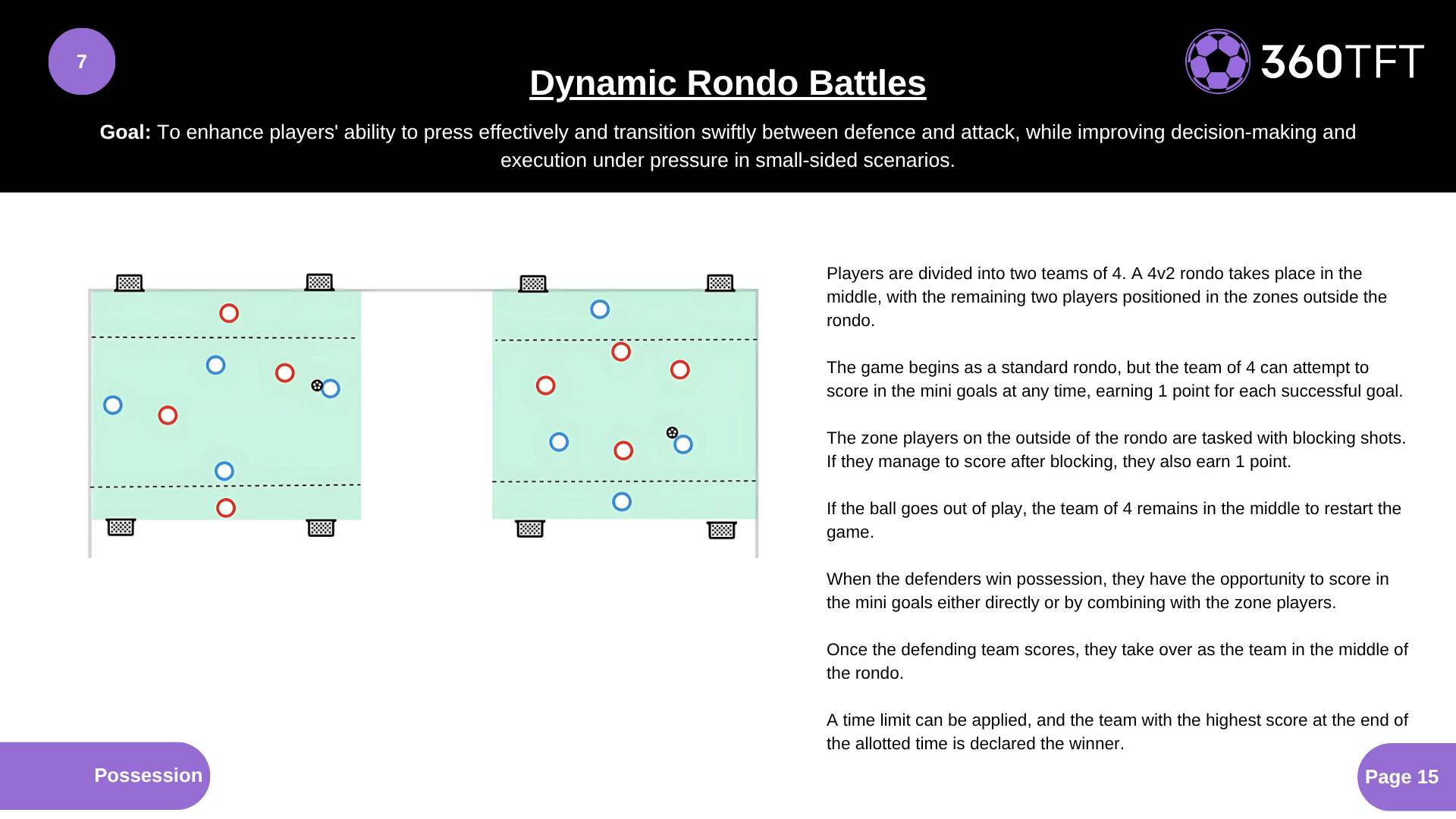
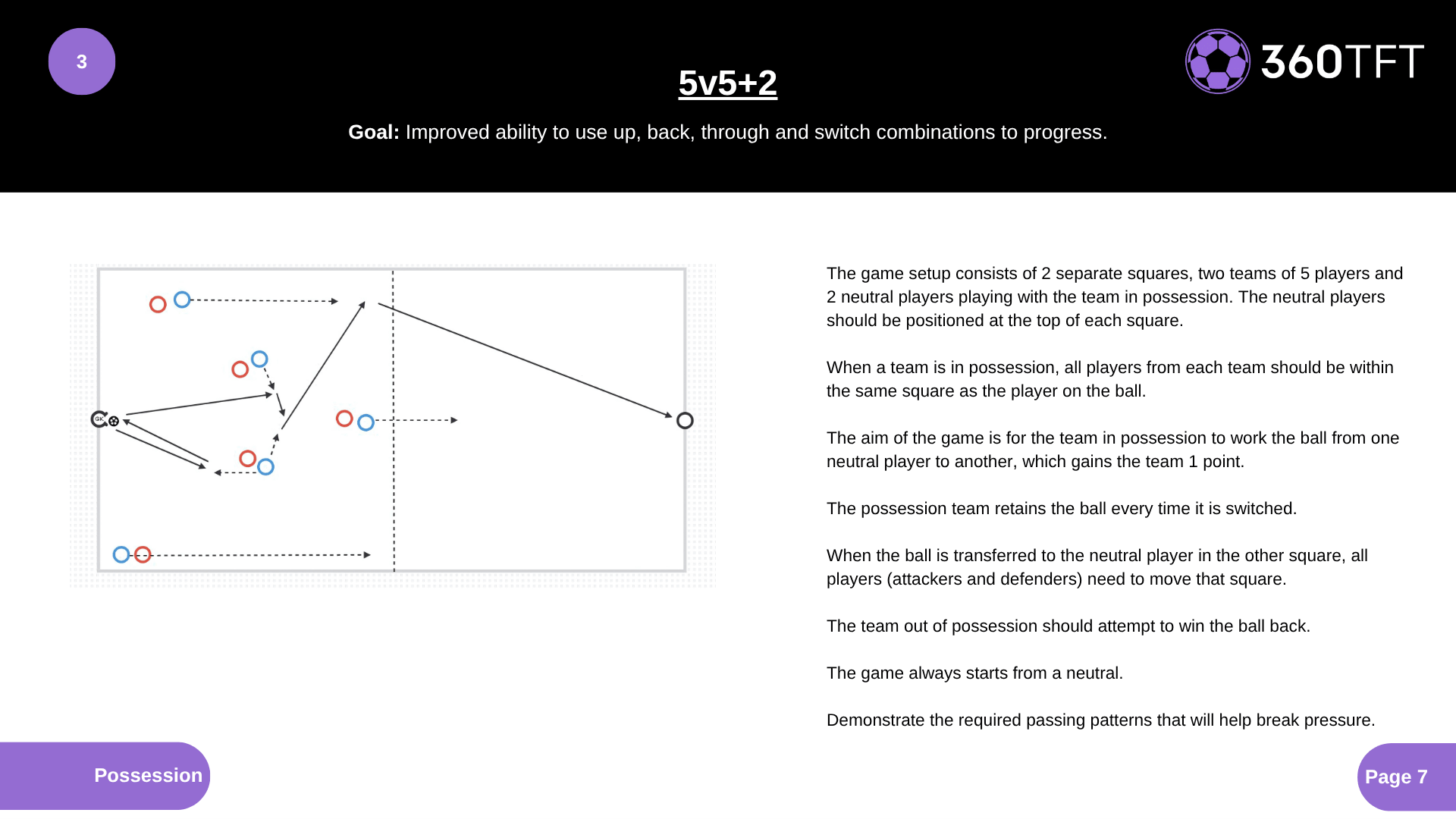
Game 1: The Possession Master (5v5+2)
Two neutral players always play for whichever team has the ball, creating a constant overload. Develops possession retention, support play and decision making under pressure, a progression on the tactical emergency session from Day 2, now applied systematically.
Key coaching points
- "Find the free man": constant scanning for neutrals
- "Keep it moving": quick pass and move
- "Create angles": support positioning off the ball
- "Switch play": use the full width when under pressure
Game 2: The Transition Tornado (4v4 with dual goals)
Two goals at each end. Score in either, then defend both immediately. Forces players to switch quickly between attack and defence, developing transition speed and game intelligence.
Key coaching points
- "Quick switch": immediate reaction to a possession change
- "Scan constantly": awareness of all four goals
- "Defend forward": press to win the ball back quickly
- "Exploit space": attack the least defended goal
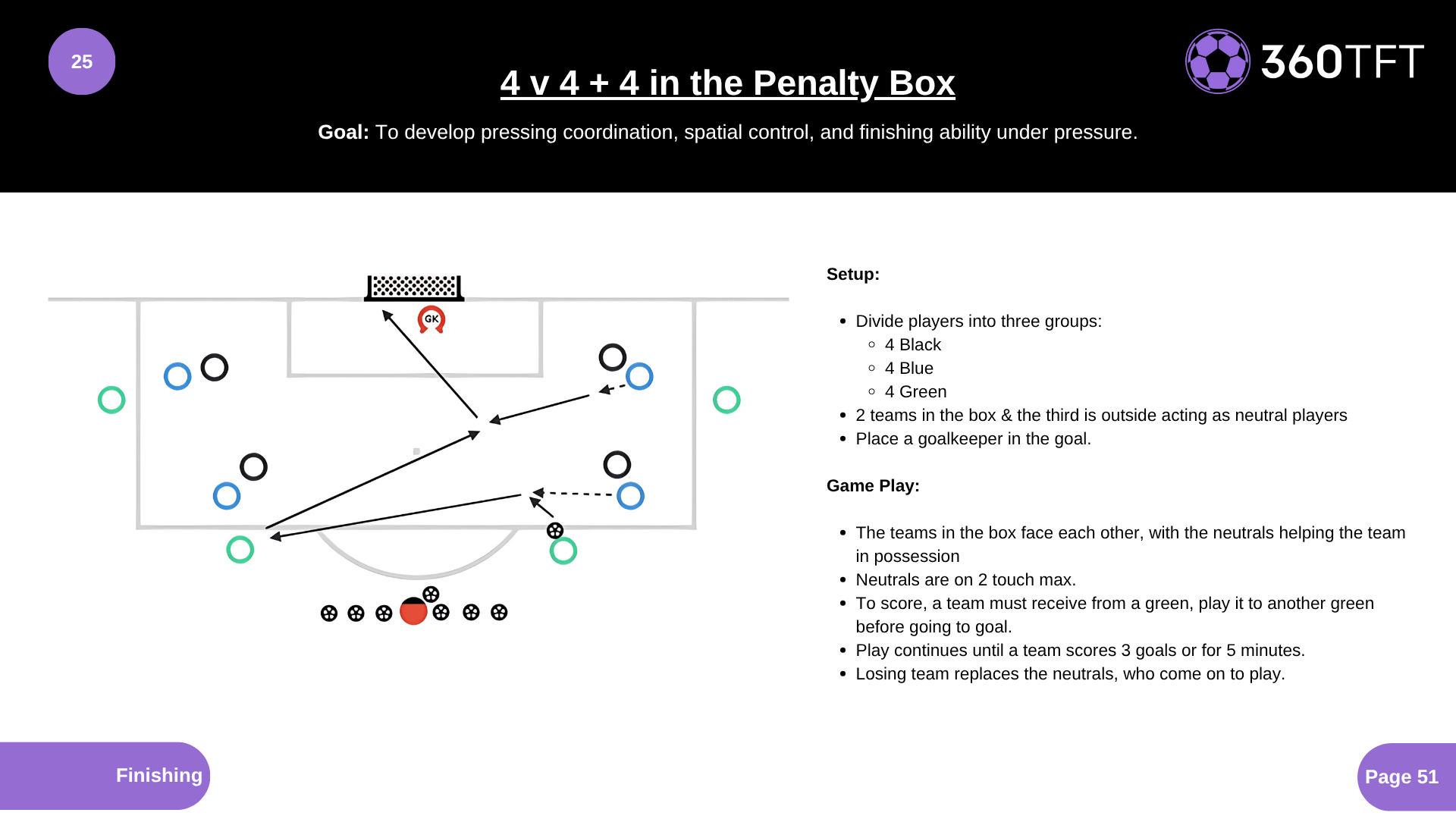
Game 3: The Finishing Factory (4v4+4 in the box)
Compressed area around the box, four attackers against four defenders plus a goalkeeper. Develops clinical finishing, creative play in tight spaces and goalkeeping under pressure. An evolution of Day 2's mental emergency session.
Key coaching points
- "One-two combinations": quick passing to create space
- "Strike early": don't hesitate when a chance appears
- "Second balls": follow up every shot
- "Low and hard": finish across the goalkeeper
When to stop and coach (20%)
Stop the game only for teaching moments that impact the whole group.
- Teachable moments: when multiple players make the same mistake
- Key principles: when core tactical concepts are being ignored
- Safety issues: dangerous play or poor technique that could cause injury
- Game understanding: when players don't understand the objectives
When to let play continue (80%)
Individual mistakes and learning opportunities happen through playing.
- Individual errors: let players learn from natural consequences
- Close decisions: don't interrupt good attacking moves
- Momentum moments: when players are in a flow state
- Competition intensity: when players are fully engaged
Individual coaching during play
Use quick, specific phrases that don't disrupt the flow of the game.
- "Check your shoulder": for scanning
- "Hold your run": for timing
- "Switch it": for changing play
- "Great decision": for positive reinforcement
Mistake 1: too many rules
Complex rules confuse players and reduce natural game flow.
Maximum: three rules per game variation
Mistake 2: wrong area size
Too small means no time to think. Too large means no pressure to improve.
Guide: around 5m x 5m per player for possession games
Mistake 3: no competition
Without competition, intensity drops and learning decreases.
Examples: points, time limits, tournaments between teams
Mistake 4: over-coaching
Stopping play every 30 seconds destroys rhythm and enjoyment.
Timing: natural breaks in play or between rounds
Connection to previous days
Day 2 link: these three games systematically develop the same skills from your emergency sessions. The Possession Master builds on the tactical fix, the Transition Tornado supports physical development, and the Finishing Factory develops the mental composure from Day 2.
Day 3 link: players with the right mindset from yesterday engage more in these games. They see mistakes as learning opportunities and compete with confidence rather than fear.
The progressive system: emergency fixes, then confidence building, then systematic training, then complete development.
Your weekly implementation plan
Week 1
Introduce one game per session. Focus on understanding the rules and basic execution.
Week 2
Add progressions. Increase intensity and competition between teams.
Week 3
Combine games in training, 15 minutes each, rotating through all three.
Week 4+
Adapt based on team needs. These become your go-to training format.
Session structure template
Warm-up (10 mins): ball mastery from Day 2
Main activity (30 mins): one of the three high-impact games
Scrimmage (15 mins): let them play and apply what they've learned
Cool down (5 mins): Day 3 mindset reinforcement
Implementation warnings
- Don't rush: master one game before introducing the next
- Observe first: watch for 2-3 minutes before making any changes
- Trust the process: small-sided games work if you let them
- Stay patient: some players need time to adapt to increased decision-making
Since I started coaching in 2010, small-sided games are the closest thing I've found to a shortcut in football coaching. They develop everything at once: technique under pressure, tactical understanding through repetition, physical conditioning through play, and mental toughness through competition. The key is letting the game teach while you guide.
When I started coaching, I tried to control every moment. Now I create the environment and let football happen. These three games change training because they mirror what actually happens in matches, not what we think should happen. Long term development still comes first, this is how you build it week to week.