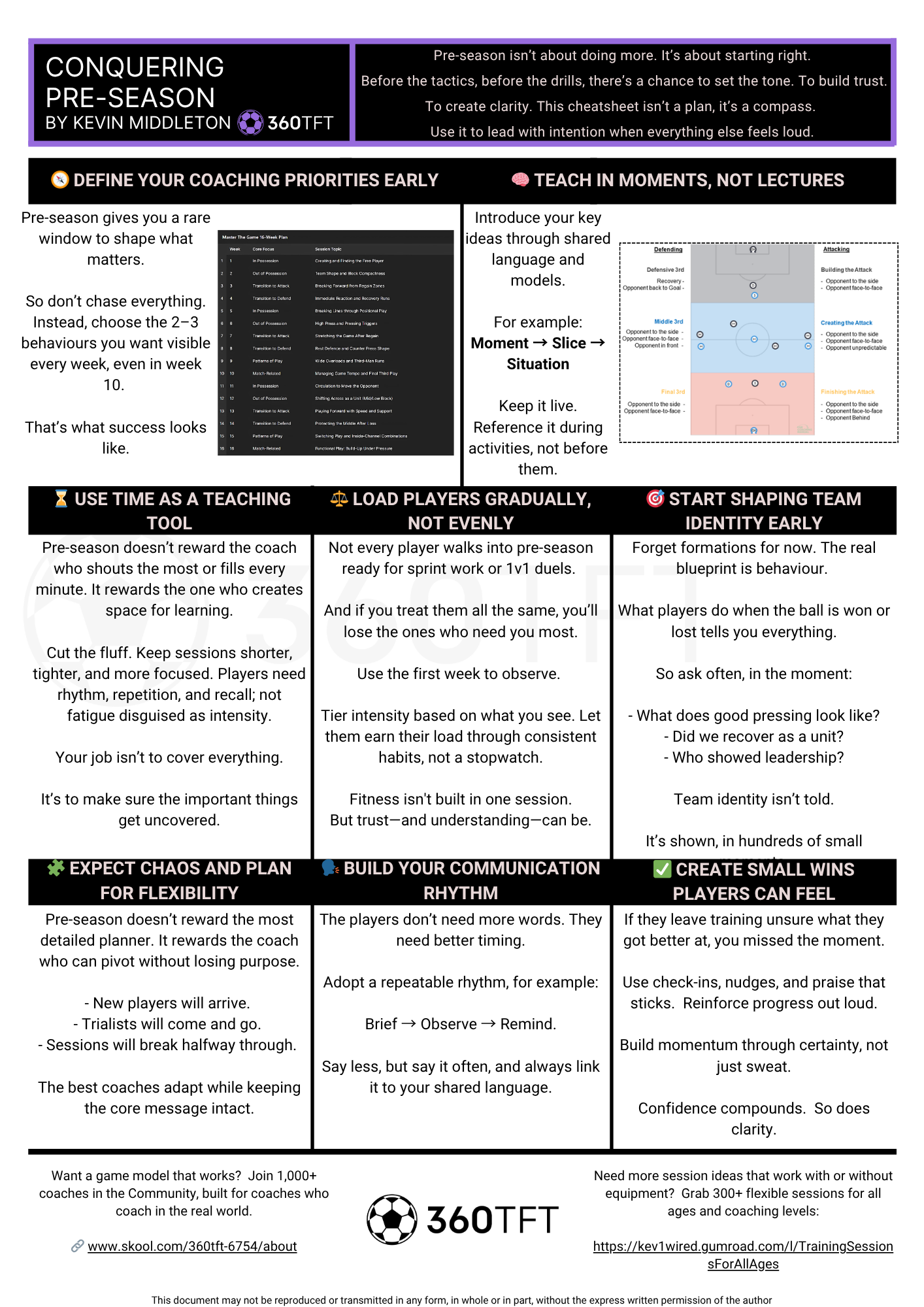
You have got eight weeks until the season starts. Eight weeks to fix what went wrong last year. But here is what most coaches do: they run players into the ground with fitness drills that look impressive but do not actually prepare them for matches.
I have watched it happen countless times. Endless laps. Beep tests. Players collapsed on the grass, completely exhausted. Then September arrives and they cannot execute a simple one-two under pressure. All that running, all that pain, and nothing to show for it when it matters.
There is a better way. Instead of attempting everything simultaneously, focus on developing adaptable, intelligent players who understand underlying principles rather than memorising positions.
Four-Phase Tactical Development
The key to effective pre-season is not cramming everything into eight weeks. It is following a logical progression that builds genuine understanding.
Phase 1: Understanding (Weeks 1-2)
Players learn the reasoning behind effective actions. Before executing, they need to understand why certain movements and decisions work in specific situations.
What this looks like in practice:
- Walk-through sessions explaining positioning concepts
- Video analysis showing why certain movements work
- Question-and-answer discussions during water breaks
- Slow-motion practice where players can think through decisions
Example: Instead of just telling your striker to “make a run,” explain why the run works. “When you move toward the defender, you pull them out of position. That creates space behind them. Your movement creates the opportunity.”
Players who understand the “why” can adapt when situations change. Players who only know the “what” fall apart when the opposition does something unexpected.
Phase 2: Application (Weeks 3-4)
Practicing principles in game situations. This phase bridges the gap between understanding concepts and using them under match-like conditions.
What this looks like in practice:
- Small-sided games with specific tactical focus
- Opposed drills where players must make real decisions
- Gradual increase in speed and pressure
- Immediate feedback on decision-making quality
Example: Run a 4v4 possession game where points are only scored by switching play. Players must scan, identify the switch opportunity, and execute under pressure. The constraint forces them to apply what they learned in Phase 1.
Phase 3: Adaptation (Weeks 5-6)
Modifying approaches based on opponent behaviour. Players learn to read situations and adjust their responses accordingly.
What this looks like in practice:
- Variable opposition tactics (sometimes press high, sometimes sit deep)
- Problem-solving sessions where players identify solutions
- Scenario training: “What do you do when they man-mark your playmaker?”
- Reduced coach intervention - let players figure things out
Example: Play a match where you secretly instruct one team to change their approach every 10 minutes. The other team must recognise the change and adapt without coach guidance. This builds game intelligence.
Phase 4: Mastery (Weeks 7-8)
Automatic execution with situational flexibility. At this stage, correct decisions and movements become instinctive.
What this looks like in practice:
- Full match simulations with realistic conditions
- Reduced coaching intervention during games
- Focus on maintaining quality under fatigue
- Pre-season friendlies with specific development objectives
Example: By week 8, when your midfielder receives the ball under pressure, they should not need to think about where to look or what options exist. Scanning, decision-making, and execution should flow automatically. If it does not, you have rushed the earlier phases.
Week-by-Week Pre-Season Structure
Here is how to structure your eight weeks for maximum development:
| Week | Focus | Session Split |
|---|---|---|
| 1 | Foundation - understanding principles | 70% technical, 30% tactical concepts |
| 2 | Building blocks - basic patterns | 60% technical, 40% small-sided games |
| 3 | Application - principles under pressure | 50% technical, 50% opposed practice |
| 4 | Integration - combining concepts | 40% technical, 60% game situations |
| 5 | Adaptation - reading opponents | 30% technical, 70% match scenarios |
| 6 | Problem-solving - player-led solutions | 20% technical, 80% match scenarios |
| 7 | Match preparation - realistic conditions | Full match simulations |
| 8 | Fine-tuning - address gaps | Targeted work + competitive matches |
Important: This is not about fitness percentages. Conditioning happens naturally through football-specific activities. A high-tempo 4v4 builds fitness while developing decision-making. Running laps builds fitness while developing… nothing else.
Five Common Pre-Season Mistakes
Mistake 1: Adopting Professional Models
Professional club pre-season programmes assume full-time training, sports science support, and elite facilities. Copying these approaches without considering amateur constraints leads to overtraining, injuries, and frustrated players.
Mistake 2: Prioritising Fitness Over Technical Work
Running players into the ground might feel productive, but pure fitness work does not develop the technical and tactical qualities that win matches. Integrate conditioning within football-specific activities. Learn more about creating real training intensity that transfers to matches.
Mistake 3: Introducing Advanced Concepts Prematurely
Complex tactical systems require foundational skills. Attempting sophisticated positional play before players can execute basic passes under pressure creates confusion rather than development.
Mistake 4: Focusing on Squad Selection
Pre-season should develop every player, not audition for starting positions. When coaches use friendlies to identify their best eleven, development opportunities get wasted.
Mistake 5: Using Friendlies Competitively
Pre-season matches exist for experimentation, not results. Treating every friendly as a must-win game prevents players from trying new positions, skills, and tactical approaches.
How to Measure Pre-Season Success
Forget about beep test scores and time trials. Here is what actually indicates effective pre-season preparation:
Signs of Success:
- Players make faster decisions under pressure
- Tactical concepts appear automatically in matches
- Players solve problems without coach intervention
- Team maintains quality when fatigued
- Players can explain why they made specific decisions
Warning Signs:
- Players look fit but confused tactically
- Lots of individual skill but poor team understanding
- Players constantly look to the sideline for instructions
- Quality drops dramatically when tired
- Players revert to bad habits under match pressure
Common Questions About Pre-Season
“What if we only have 4 weeks?”
Compress the phases but do not skip them. Spend one week per phase instead of two. Understanding still comes before application. You will have less depth, but the progression matters.
“How many sessions per week?”
For amateur teams: 2-3 sessions plus a match works well. Quality beats quantity. Three focused sessions outperform five exhausting ones.
“What about fitness testing?”
If you must test, do it at the start and end. But understand that fitness tests measure fitness, not football ability. A player with great beep test scores who cannot read the game will not help you win matches.
“Should we focus on our formation?”
Principles first, formations second. Players who understand attacking and defending principles can adapt to any formation. Players who only know their position in a 4-3-3 fall apart when you switch to 4-4-2.
Building Players Who Understand The Game
Successful teams train smarter during pre-season, building players capable of understanding games deeply and adapting to competitive pressures. This foundation drives sustained seasonal success.
The goal is not to peak in August. It is to create players who continue developing throughout the season because they understand the game’s underlying principles.
Think about it this way: would you rather have players who are incredibly fit in August but tactically clueless? Or players who understand the game and build fitness naturally throughout the season?
The answer is obvious. Yet most amateur coaches still default to fitness-focused pre-seasons because that is what they have always seen.
Your pre-season sets the tone for everything that follows. Make it count by building understanding, not just fitness.
Want a complete pre-season framework?
The Football Coaching Academy provides week-by-week guidance for building intelligent, adaptable players. Join 1,600+ coaches transforming how they prepare teams. $1/month to start.