Name the football problem
Is the issue protecting the ball, creating an overload, pressing together, playing through a line or keeping the team's shape?
A smaller game is not automatically a better game. Start with what your players need to notice, decide and execute, then choose the smallest format that still recreates that problem.
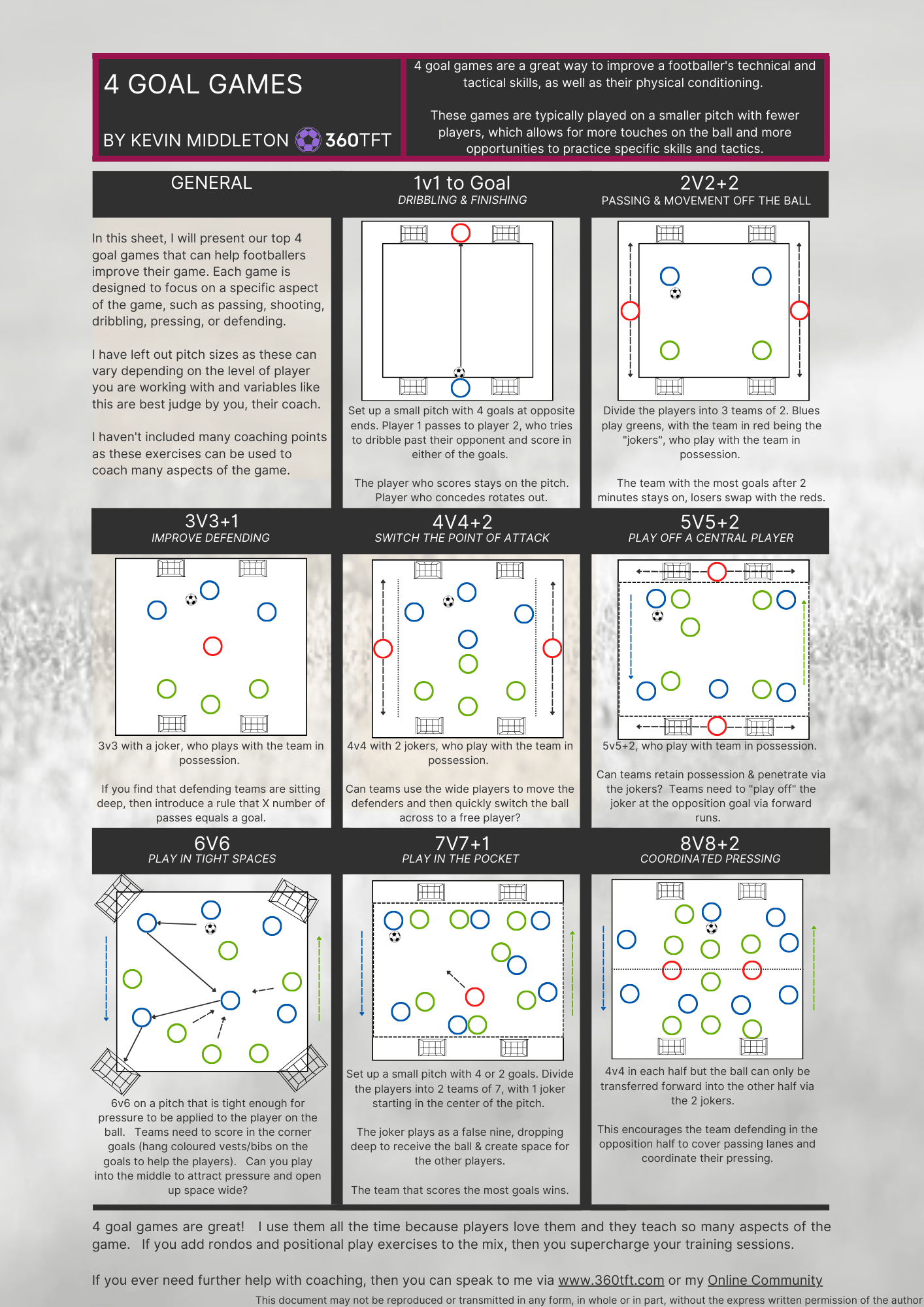
The format changes what players can see and solve. Fewer players usually bring the action closer. More players introduce wider relationships, longer distances and more positional reference points. Neither is the destination on its own.
Is the issue protecting the ball, creating an overload, pressing together, playing through a line or keeping the team's shape?
Player numbers, pitch shape, goals, zones and scoring rules should make the target behaviour more likely without scripting every decision.
If the problem never appears, change the game. If players cannot solve it yet, simplify the information before adding more instructions.
These are coaching uses, not fixed age rules. Competition formats and age bands vary, so check your own association's current rules before using any format for match preparation.
Useful when you want repeated moments around the ball: receiving under pressure, support angles, individual defending and quick transitions.
Useful for connecting a goalkeeper, defensive line, midfield and attack while keeping every player close enough to influence the game.
Useful for width, depth, playing between units and helping players manage more options without jumping straight into a full 11v11 picture.
Useful when the whole-team distances and position-specific relationships are essential to the problem. It is a test of transfer, not the answer to every session.
Start with the format your players meet in matches, then move smaller when you need more repeated involvement around a particular problem. Check your local association's current rules because age formats differ between countries and competitions.
Use positions when they help players recognise useful relationships. Avoid turning a learning game into a set of fixed spots that prevents players from scanning, covering and solving the situation.
Change one meaningful constraint at a time. Adjust the space, numbers, direction, target or restart. You should be able to explain which football problem that change is helping the players solve.
Move up when the next layer of relationships matters. If a player can solve the action in 3v3, test whether they can recognise the same moment with more teammates, opponents and space around them.
The Football Coaching Academy organises coaching resources around 3v3, 7v7, 9v9 and 11v11 environments, alongside session planning and player development guidance.